
Contacto de lenguas y variación
DOI:
https://doi.org/10.5281/zenodo.11111143Palabras clave:
contacto de lenguas, lenguas y variaciónResumen
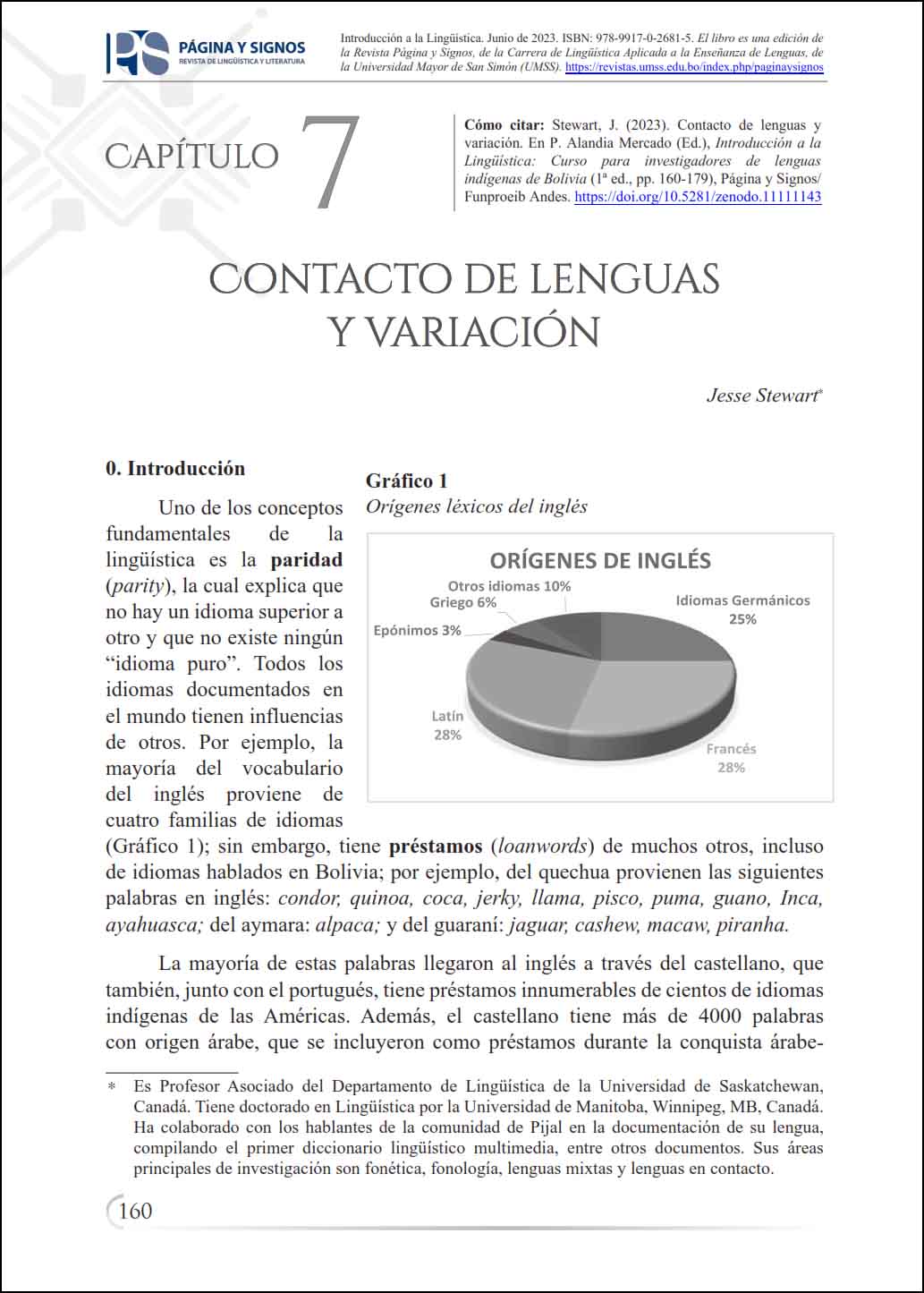
Uno de los conceptos fundamentales de la lingüística es la paridad (parity), la cual explica que no hay un idioma superior a otro y que no existe ningún “idioma puro”. Todos los idiomas documentados en el mundo tienen influencias de otros. Por ejemplo, la mayoría del vocabulario del inglés proviene de cuatro familias de idiomas (idiomas germánicos, francés, latín, epónimos, griego y otros); sin embargo, tiene préstamos (loanwords) de muchos otros, incluso de idiomas hablados en Bolivia; por ejemplo, del quechua provienen las siguientes palabras en inglés: condor, quinoa, coca, jerky, llama, pisco, puma, guano, Inca, ayahuasca; del aymara: alpaca; y del guaraní: jaguar, cashew, macaw, piranha.
La mayoría de estas palabras llegaron al inglés a través del castellano, que también, junto con el portugués, tiene préstamos innumerables de cientos de idiomas indígenas de las Américas. Además, el castellano tiene más de 4000 palabras con origen árabe, que se incluyeron como préstamos durante la conquista árabe-musulmana en la Península Ibérica durante más de novecientos años. Algunas de las palabras de origen árabe comunes en castellano son: almuerzo, almohada, ajedrez, atún, bagre, café, chivo, espinaca, fideo, limón, loco, máscara, quintal, talco, taza, zanahoria, entre muchas más. Con base en estos ejemplos, se puede definir un préstamo como una palabra o parte de una palabra que se comparte de un idioma a otro, y la única manera en la que esto es posible es a través del contacto con hablantes de otros idiomas, ya sea en persona o por documentación (escrita, audio, video, etc.).
Con esas consideraciones, en este capítulo veremos diferentes fenómenos que resultan del contacto de lenguas, desde los préstamos, con sus diferentes efectos en los sistemas en contacto, hasta la emergencia de nuevas lenguas, cuya clasificación presentamos.
Referencias
Adelaar, W. (2017). A typological overview of Aymaran and Quechuan language structure. In A. Y. Aikhenvald & R. M. W. Dixon (Eds.), Part III - Typological Profiles of Linguistic Areas and Language Families (pp. 651–682). Cambridge University Press. https://doi.org/10.1017/9781316135716.021
Bailey, C. J., & Maroldt, K. (1977). The French lineage of English. In J. Meisel (Ed.), Langues en contact-pidgins-creoles-Languages in contact (pp. 21–53). Narr Francke Attempto.
Bruil, M. (2008). Innovations in the Ecuadorian Converb Systems: Grammatical change in language contact situations. [MA Thesis]. University of Leiden.
Chimbo Aguinda, J. J., Ullauri Velasco, M. A., & Shiguango Andi, E. E. (2008). Shimiyukkamu-Diccionario: Kichwa-Español, Español-Kichwa (Segunda). Benjamín Carríon.
Eberhard, D. M., Gary Simons, & Charles Fennig. (2020). Ethnologue: Languages of the World (23rd ed.). SIL International. http://ethnologue.com
Epps, P., & Law, D. (2019). Language Contact (J. Darquennes, J. C. Salmons, & W. Vandenbussche, Eds.; Vol. 1, p. 866). Walter de Gruyter GmbH & Co KG.
Escobar, A. M. (2011). Spanish in Contact with Quechua. In M. Díaz-Campos (Ed.), The Handbook of Hispanic Sociolinguistics (pp. 323–352). Blackwell Publishing Ltd.
Fought, C. (2010). Linguistic contact. In R. Hickey (Ed.), The handbook of language contact (pp. 229–319). Wiley-Blackwell.
Gnerre, M. (1975). A Spanish pidgin of the Shuar [Manuscript]. University of Rome.
Grant, A. P. (2015). The Oxford Handbook of the Word (J. R. Taylor, Ed.; p. 960). OUP Oxford.
Haboud, M. (1998). Quichua y Castellano en los Andes Ecuatorianos. Los Efectos de un Contacto Prolongado. Abya-Yala.
Hardman, M. (2013). Dictionary of the Jaqi languages: Aymara, Jaqaru and Kawki. Ethnos Project. http://test.aymara.ufl.edu/dictionary.html
Hardman-De-Bautista, M. J. (1982). The mutual influence of Spanish and the Andean languages. Word, 33(1–2), 143–157. https://doi.org/10.1080/00437956.1982.1143572
Herrera, Y., Manzanares, M., Woods, S., Crosbie, C., & Decker, K. (2007). Kriol – Inglish Dikshineri; English – Kriol Dictionary (P. Crosbie, Ed.; 1st ed.). SIL International.
Hickey, R. (2010). Language contact: Reconsideration and reassessment. In R. Hickey (Ed.), The handbook of language contact (pp. 1–29). Wiley-Blackwell.
Krippner, S. (2020). Gottschalk-Batschkus. In C. E. Gottschalk-Batschkus & J. C. Green (Eds.), Handbook of ethnotherapies. BoD.
Lefebvre, C. (2006). Creole Genesis and the Acquisition of Grammar: The Case of Haitian Creole (Vol. 88). Cambridge University Press.
Lefebvre, C. (2005). Relexification: A process available to human cognition. 27, 125–139.
Lefebvre, C., & Therrien, I. (2007). On Papiamentu ku. In J. Siegel, J. Lynch, & D. Eades (Eds.), Language description, history and development: Linguistic indulgence in memory of Terry Crowley (Vol. 30, pp. 169–182). John Benjamins Publishing.
Mackenzie, I. (1999). The Linguistics of Spanish [University Personal Webpage]. Palenquero. https://www.staff.ncl.ac.uk/i.e.mackenzie/palenque.htm
Manley, M. S. (2007). Spanish in Contact: Policy, Social and Linguistic Inquiries (K. Potowski & R. Cameron, Eds.). John Benjamins Publishing.
McConvell, P., & Meakins, F. (2005). Gurindji Kriol: A mixed language emerges from code-switching. Australian Journal of Linguistics, 25, 9–30.
Meakins, F., & Stewart, J. (accepted). Mixed Languages. In S. Mufwene & A. M. Escobar (Eds.), Cambridge Handbook of Language Contact. Cambridge University Press.
Moore, D., Facundes, S., & Pires, N. (1994). Nheengatu (Língua Geral Amazônica), its History, and the Effects of Language Contact. Survey Of California And Other Indian Languages.
Muysken, P. (1981). Halfway between Quechua and Spanish: The case for relexification. In A. R. Highfield (Ed.), Historicity and variation in Creole studies (Vols 57–78). Karoma Publishers.
Muysken, P. (1997). Media Lengua. In S. Thomason (Ed.), Contact languages: A Wider Perspective (pp. 365–426). J. Benjamins Pub. Co.
Muysken, P. (2015). From nominal predicate to dictic clausal highlighter: The development of hina ‘like’. In M. Manley & A. Muntendam (Eds.), Quechua Expressions of Stance and Deixis. Brill.
Palacios Alcaine, A. (2005). La influencia del Quichua en el español andino Ecuatoriano. In Homenaje al Dr. Luis Jaime Cisneros (Vol. 1, pp. 389–408). Pontificia Universidad Católica del Perú.
Parker, G., & Ibañez, A. (1964). English-Quechua Dictionary—Cuzco, Ayacucho, Cochabamba. US Department of Health, Education, and Welfare.
Quartararo, G. (2017). Evidencialidad indirecta en aimara y en el español de la Paz: Un estudio semántico-pragmático de textos orales [PhD Dissertation, Stockholm University]. https://su.diva-portal.org/smash/get/diva2:1091898/FULLTEXT01.pdf
Quiroz Villarroel, A. (2000). Gramática Quechua Boliviano Normalizado (1st ed.).
Ross, M. (2007). Calquing and metatypy. Journal of Language Contact, 1(1), 116–143. https://doi.org/doi.org/10.1163/000000007792548341
Ross, M. D. (1999). Exploring metatypy: How does contact-induced typological change come about? [Keynote talk]. Australian Linguistic Society’s annual meeting, Perth.
Rothwell, W. (1998). Arrivals and departures: The adoption of French terminology into middle English. English Studies, 79(2), 144–165. https://doi.org/10.1080/00138389808599121
Simson, A. J. (1886). Travels in the wilds of Ecuador. Sampson Low, Marston, Searle, and Rivington.
Stewart, J. (2013). Stories and traditions from Pijal: Told in Media Lengua (1st ed.). CreateSpace.
Stewart, J. (2020a). A preliminary, descriptive survey of rhotic and approximant fricativization in Northern Ecuadorian Andean Spanish varieties, Quichua, and Media Lengua. In R. Rao (Ed.), Spanish Phonetics and Phonology in Contact: Studies from Africa, the Americas, and Spain. John Benjamins. https://doi.org/10.1121/10.0000991
Stewart, J. (2020b). Media Lengua Dictionary. Dictionaria, 13, 1–3191.
Thomason, S. (2001). Language contact: An introduction. Edinburgh University Press.
Thomason, S. (2010). Contact explanations in linguistics. In R. Hickey (Ed.), The handbook of language contact (pp. 29–47). Wiley-Blackwell.
Winford, D. (2010). Contact and borrowing. In R. Hickey (Ed.), The handbook of language contact (pp. 1–29). Wiley-Blackwell.
Zajícová, L. (2009). El Bilingüismo Paraguayo. Usos y Actitudes hacia el Guaraní y el Castellano. Iberoamericana y Vervuert.
Descargas
Publicado
Número
Sección
Licencia

Esta obra está bajo una licencia internacional Creative Commons Atribución-NoComercial 4.0.